












A Design Featuring Proto-Sinaitic Descendant Scripts
In August of 2024, I read an article in Archaeology Magazine about the oldest known recorded instance of the use of Proto-Sinaitic alphabetical symbols, discovered in a tomb in Egypt. The symbols were based on Egyptian hieroglyphs but instead of representing a concept, the symbols each represented a sound. String them together and you get a spoken word. Writing out sounds made it possible to adapt the symbols to any - any - spoken language, and the new form of writing caught on all over the Middle East, changing its appearance as it adapted to the needs of the language and the tools used for writing in the environments in which the language was spoken.
Pretty soon, the Phoenicians were using Proto-Sinaitic. Then the Greeks adapted Phoenician to their language - and the Etruscans used Greek, and the Romans used Etruscan to create the Latin alphabet. I had never really thought much about how the Latin alphabet developed, so I bought a book called Letter Perfect by David Sacks to learn more.

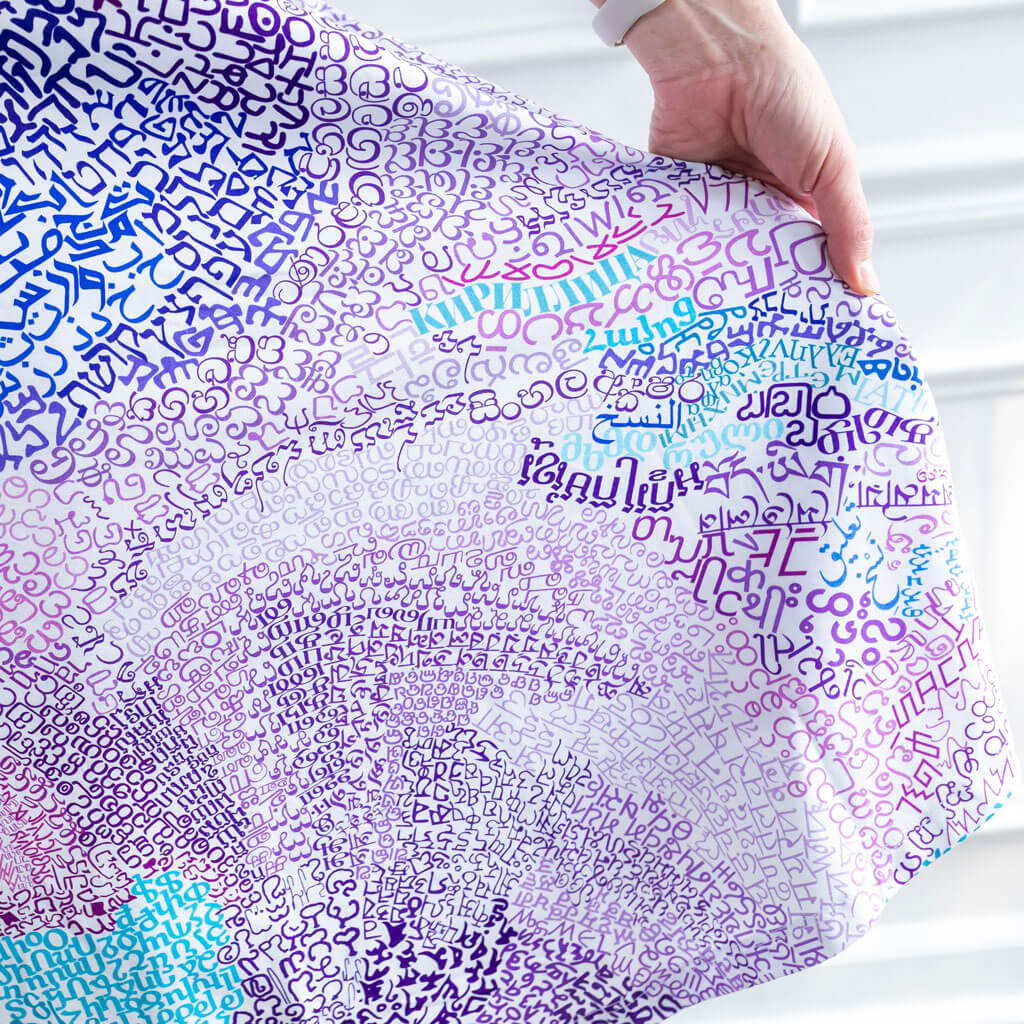
Not only was it fascinating to see how the familiar (to me) Latin letters evolved from ancient scripts, I learned that a huge number of scripts used for hundreds of languages all evolved from Proto-Sinaitic. So I decided to make a textile design featuring all those currently in use, along with their ancestors, in order to give a sense of the breadth and depth of Proto-Sinaitic's spread across Europe, Africa, and Asia, and then with colonization into Oceania and the Americas.
The development of writing systems is not the same as the development of spoken language. This design showcases the former and not the latter. For the ancient scripts that are no longer used, I traced photos of inscriptions by hand and digitized them, attempting to capture the appearance of letters carved in stone or written in manuscripts. I included these ancient, extinct scripts because they were the links in the chain of transmission and helped show how modern scripts developed, but there are hundreds more scripts that have gone extinct and have no modern descendants.
I did not include every extinct descendant and sibling - it would have tripled (or more!) the number of scripts. I also unwisely (though unwittingly) included more of the development of scripts that came from Greek rather than Aramaic, because I started on Greek descendants first. When I finished Greek and then began working on Aramaic, I quickly realized I would not be able to include the same type of middle-development versions of all the scripts, simply because there are SO MANY. I suppose I should probably have deleted the middle-range Greek scripts to make it fair, but they were interesting and I had finished them, and they fit nicely into the spiral, so you do see more of the progression in Greek than for the Aramaic. Apologies.
I have included all the modern scripts currently in use that have Proto-Sinaitic as their ancestor, unless they are nearing extinction. I chose not to include diacritics but rather only the "base" form of each letter/syllable. In some cases I have shown some later additions to scripts that extend alphabets/abugidas to accommodate certain sounds in various languages, but again only if they are distinct from other letter forms that already exist in the script.
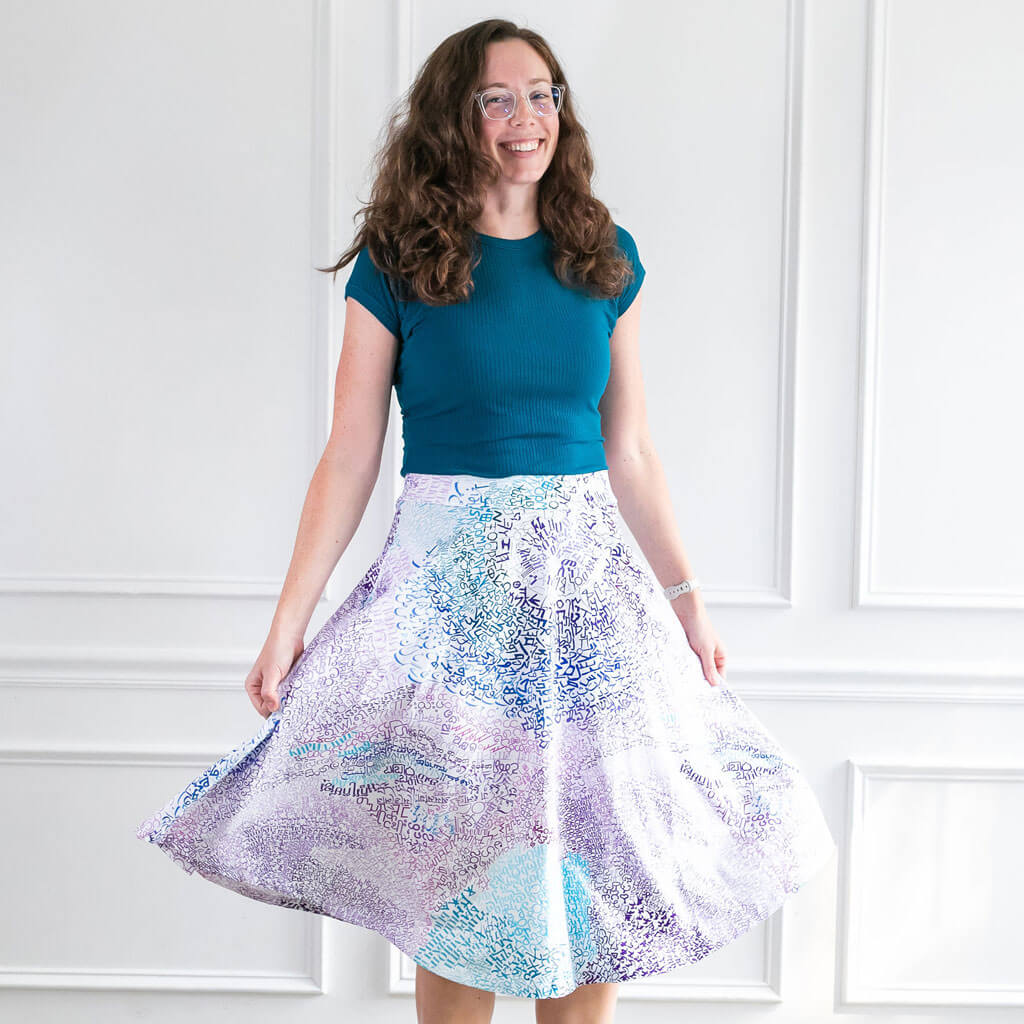
There are two areas to the design. The evolution of letter forms spirals out from Proto-Sinaitic into Phoenician and its multitudinous descendants; the inward direction shows Ancient South Arabian and its single modern descendant, Ge'ez. The colors also indicate the relationship of the scripts to each other - darker blue scripts evolve from Phoenician into Ge'ez (blue) and Aramaic (blue) and eventually outward toward Arabic (light blue), while as the scripts journey east with Brahmic, they turn purple. The Greek descendants are shades of teal. Older scripts are darker hues; more modern ones are lighter.
The outermost edges of the spiral join up with the modern names of the scripts, each written in its own script. These are arranged by latest-to-evolve and move inward toward the oldest script still in use (Greek). The names of ancestor/extinct scripts are not included.
Each featured script in the design is discussed briefly below. I have linked to the Wikipedia article on each script, but that is just a starting point. Omniglot is a great resource for learning more, and many scripts have online preservation societies and clubs to help keep them alive. All the dates I have given are approximate; I'm sure we haven't even begun to discover the earliest samples of many of these scripts, so I gave the earliest documented date thus far.
Some interesting things I learned:
-I learned a little about how I process visual information: I had a much more difficult time remembering and distinguishing among letter forms that bear little or no resemblance to the forms I'm already familiar with. For example, when I was looking for a particular glyph, I would describe it in my head as "h with curlicues on top and a flourish at the bottom". But if the letter form didn't look like anything I usually use, I couldn't describe it to myself or remember what it looked like. Even harder were scripts where the letter forms all look like the same familiar letters (to me). Take a look at Cham - to me every letter looks like M or N, so trying to tell the forms apart was challenging.
-This problem, however, helped me understand why certain letter forms persisted into nearly every script: a circle, a straight line, X, T. They are both simple and different from each other and therefore easier to remember. The only factor that would eliminate these letter forms from a script is the writing materials....
-The writing materials available had an outsize impact on the development of each script. For example, many Southeast Asian languages were originally written on palm leaf manuscripts. If you try to draw a straight line on this material, it will crack - so many of these scripts have letter forms that employ curves. Using a brush pen (held vertically rather than at an angle) will affect whether a language has a slant to it, heavy strokes, and even the direction the script can be written. Scripts that were mainly used for inscriptions use vertical, straight strokes (ie, Latin). However, when the Latin language began to be written in manuscript form, it began to develop more curves, which gave rise to...
-Miniscule and majuscules - the Greek and Latin scripts are unusual because they have case. The vast majority of scripts do not have upper and lowercase. Even those that do (like Georgian) have mostly just larger and smaller variants of the same basic letter form, rather than completely different-looking letters.
-Alphabets are also far less common than abugidas (see Vocabulary).
These types of little details gave me new perspective on the challenges of learning a language and how our minds are molded by the systems our cultures use.
VOCABULARY
In an alphabet, letters represent single sounds, and vowels have distinct letter forms. In an abugida, letters represent whole syllables (consonant + vowel) and diacritics are required to change the vowel that accompanies the base consonantal sound (almost always, the long a sound); most abugidas also have single vowel forms. In an abjad, no vowels are indicated and a word's meaning must be derived from context (the reader has to figure out the missing vowel sounds).
A boustrophedon is a method of writing in which, when the end of a line is reached, the next line starts from the opposite direction and the letter shapes are drawn mirror-image (guess how many boustrophedons there are - not many!). Majuscule letters are what Latin script users consider uppercase letters (large scale), to differentiate them from miniscule letters (lowercase). Most scripts don't have a miniscule form.
- Proto-Sinaitic
Proto-Sinaitic | ca. 2400 BCE | abjad | RtL, boustrophedon | NOT IN USE

There are very few examples of this mother script, Proto-Sinaitic. It is at least 4000 years old (possibly much older - I just read an article with new evidence that it could be 6000 years old) and was based on Egyptian hieroglyphics. The genius of Proto-Sinaitic was that the symbols stood not for words, but for sounds. This made it versatile and adaptable to the needs of spoken language. It spread into three main branches - Phoenician, South Semitic, and Libyco-Berber.
Libyco-Berber spread south into the Sahara. The Tuareg people still use a modern version of it (Tifinagh) for some symbolic purposes, but since they officially use Latin for everything else, I did not include any Libyco-Berber families.
Ancient South Arabian | fl. 1000 BCE | abjad | RtL, boustrophedon | NOT IN USE

Ancient South Arabian is one of two descendants of Proto-Sinatic (the other is the group of Ancient North Arabian script variants, all of which are extinct) and is about 3500 years old. It fell out of use around 600 CE when Arabic replaced the scripts in use in the Arabian peninsula and Horn of Africa. It has only one modern descendent - Ge'ez.
Phoenician | 1000 BCE | abjad | RtL | NOT IN USE

The Phoenician script is a direct descendant of Proto-Sinaitic and was used to write various Canaanite languages. It spread across the Mediterranean and Asia, giving rise to many scripts used as far away as Indonesia and the Philippines. I could not find an image of an inscription that showed two of the letters (śāmek and šīn), so I did not presume to draw them.
Aramaic | 800 BCE | abjad | RtL | NOT IN USE

The Aramaic script is a descendant of Phoenician. It was used to write Aramaic, Persian, and other (primarily Middle Eastern but also some Central Asian) languages. Its descendants spread across the Middle East and into Asia.
Hebrew | 800 BCE | abjad | RtL | IN USE

The Hebrew script is so similar to Aramaic that I did not include the Paleo-Hebrew version which emerged around 800 BCE; instead the depicted script is the square-style variant that came into use around 100 BCE and has remained largely unchanged for over two milllenia. Hebrew is used to write the Hebrew language and its dialects/derivatives such as Yiddish.
Greek | 800 BCE | alphabet | LtR | IN USE

The Greek script came directly from Phoenician and is the earliest alphabet known to include separate letter forms specifically for vowels. I also illustrated a few letters taken from the Dipylon inscription in order to show an ancient version of Greek that's closer to Phoenician. Even then, the script has not changed much in 2500 years. Greek is one of just a few scripts that have both a majuscule and miniscule form. Armenian and Georgian are descendants of Greek miniscule, not Greek majuscule - the Latin script ultimately derives from the majuscule form. The spoken Greek language is the only modern language written in the Greek script.
Etruscan | 700 BCE | alphabet | LtR | NOT IN USE

The Etruscan alphabet was the immediate parent of the Latin alphabet, used to write the Etruscan language, and is itself a descendant of Greek majuscule. It survived until the first century before the common era.
Latin | 700 BCE | alphabet | LtR | IN USE

The Latin alphabet also has both a majuscule and a miniscule form, which is why I included the development of both. It has been in continuous use and has changed little in over 2700 years. About 36% of the world's people use the Latin alphabet (representing more than 3,000 languages) as their primary written script, and many more use it as a secondary or tertiary script. It has hundreds of diacritics, ligatures, multigraphs and other extensions; I included only a few but you can browse through them.
Samaritan | ca. 600 BCE | abjad | RtL | IN USE

I find the Samaritan script to be one of the most interesting that I studied because it still looks so much like Phoenician. The letter forms in some cases are nearly identical, such as ࠄ and ࠌ. It is only now used for liturgical purposes among the Samaritans, who live in the West Bank of Palestine.
Brahmi | ca. 300 BCE | abugida | LtR | NOT IN USE

Although some scholars argue that Brahmi is indigenous to India, I side with the camp that agrees it was at least influenced by Aramaic, so I included it and all of its descendants that are still in use (along with a few "bridge" scripts that show how they evolved). Brahmi has nearly 200 descendants. From India, it fanned out and evolved across South and East Asia, with so many variations that within four hundred years of its appearance, most readers had moved on to using one of its descendants. It was used to write the Prakrit languages of India, and later Sanskrit.
Tamil-Brahmi | ca. 200 BCE | abugida | LtR | NOT IN USE

As Brahmi spread east and south through India, it was adapted for the Old Tamil language and so developed into the Tamil-Brahmi script, which in turn gave rise to scores of descendants that spread throughout Southeast Asia. Though Tamil-Brahmi itself died out within a few hundred years, its primary descendant, Pallava, is still in use and it is very easy to spot the close relationship between the two.
Bhattiprolu | ca. 200 BCE | abugida | LtR | NOT IN USE

The script of Bhattiprolu is significant mainly because inscriptions of it were used as a "Rosetta Stone" to understand Tamil-Brahmi. Bhattiprolu links Ashokan (northern) Brahmi to Tamil (southern) Brahmi; it also may have influenced or given rise to Kannada. It is named for the village where the inscriptions were found, and to date no other examples have been discovered. It was used to write the Prakrit language.
Nabataean | 100 BCE | abjad | RtL | NOT IN USE

Before the spread of Arabic, the Nabataean script was used to write the Nabataean Aramaic & Arabic languages. There are only a few examples of it, mostly graffiti and inscriptions. It is the parent language of Arabic.
Syriac | 100 CE | abjad | RtL | IN USE

Syriac is one of the oldest continuously-used scripts, still used to write Syriac, as well as other languages from the same region. It has hardly changed at all in over two thousand years!
Coptic | ca. 100 CE | alphabet | LtR | IN USE

About 2/3 of Coptic letter forms come from Greek miniscule, with the others originating from Demotic (hieroglyphs that came to be used as sounds). It arose during the Ptolemaic era from a need to accommodate sounds in the Egyptian language that did not exist in Greek. It is used today mostly for religious texts, since Arabic has replaced Coptic as the main language of Egypt.
Sogdian | ca. 100 CE | alphabet | Vertical:LtR, Horizontal:RTL | NOT IN USE

Used to write the Sogdian language of Central Asia, the Sogdian script is a close descendant of Aramaic and Syriac. This is a Silk Road script and is so interesting because as the centuries passed, some users rotated it 90 degrees and began writing it vertically (influence from East Asia). Finding examples of the letter forms was tricky, since as you can see, some are nearly indistinguishable from each other.
Ge'ez | 100 CE | abjad (RtL) --> abugida | LtR | IN USE

Ge'ez is the only current-use descendant of Proto-Sinaitic that is not related to Phoenician. Its parent is instead Ancient South Arabian. Ge'ez is used to write the languages of Ethiopia and Eritrea. The darker letters are the main forms and direct descendants of Ancient South Arabian; the lighter letters are variants and punctuation marks (Ge'ez had a lot more room than other scripts, so I was able to fill space).
Mandaic | 200 CE | alphabet | RtL | IN USE

The Mandaic script is unusual because the vowels are written out, which makes the script an alphabet and not an abjad. You can jump down a really deep, really interesting rabbit hole pursuing the history of Mandaic and the Mandaeans, an ethnoreligious group from southern Iraq who believe John the Baptist was the final prophet. Their written language is deeply entwined with their religion.
Gupta | 300 CE | abugida | LtR | NOT IN USE

Although it was only in use for a few hundred years, Gupta was an incredibly important bridge script from Brahmi to other scripts of India, some of which became the main scripts for the languages spoken in their respective regions. Gupta was used to write Sanskrit.
Kadamba | 300 CE | abugida | LtR | NOT IN USE

This little image is all that I could identify for Kadamba; it was difficult to find sources that showed what the letter forms looked like, and (more importantly for this design) which I could positively identify as actually being particular letters. It developed in South India from Brahmi and was immediately adopted for writing Kannada and Telugu, both of which developed into their own (very closely related) scripts.
Kannada | 300 CE | abugida | LtR | IN USE

Isn't Kannada just gorgeous?! The script is a descendant of Kadamba (from Brahmi). It developed in Southern India and is used to write the Kannada language of Karnataka (as well as a few others). Kannada shares many letter forms with Telugu, which developed concurrently with it until about the thirteenth century CE, when Telugu truly came into its own.
Pallava | 300 CE | abugida | LtR | IN USE

Pallava has some really awesome features, like the interesting thick or thin letter forms. Most importantly, dozens of offshoots of Pallava developed, spreading as far as Indonesia and Laos. The script was developed to write Sanskrit but was and is used for many of the languages of southern India and southeast Asia.
Cham | 350 CE | abugida | LtR | IN USE

The Cham script is one of the oldest descendants of Brahmi, used by Cham speakers (Vietnam/Cambodia). If a person is not literate when they die, a Cham priest will spend four days post-mortem teaching the deceased to write in the Cham script so that they can enter the afterlife. This script was one of the most difficult for me to work with; its unique and distinctive shapes made distinguishing among the letter forms a challenge.
Tamil | 400 CE | abugida | LtR | IN USE

The Tamil script is one of the oldest, continuously used Brahmic descendants. It is used to write the Tamil language spoken throughout southern India, Sri Lanka, and Singapore. It has changed somewhat over the last 1600 years and has been influenced by nearby developing Brahmic scripts. The spoken language is also one of the oldest continuously used languages in the world, dating back at least to 300 BCE. It was the main language of South Asian trade in the first millenmium CE.
Armenian | 405 CE | alphabet | LtR | IN USE

The Armenian script developed around the same time as Georgian, also from Greek miniscule, although it could have predated the official invention in 405 by Mesrop Mashotots since Philo of Alexandria mentions its existence around 10 CE. It has distinct majuscule and miniscule letter forms, which I included. It is used exclusively to write the Armenian language.
Georgian | ca. 430 CE | alphabet | LtR | IN USE

There are three writing systems for Georgian, two of which are used mostly for art and religion, which is why I chose to depict the third, most recently developed script, Mkhedruli. I also included extensions that have been added to it for use in some languages other than Georgian. The script does have majuscule and miniscule forms but since they are nearly identical I did not include both.
Siddham | ca. 580 CE | abugida | LtR | NOT IN USE

The word "siddham" means "perfected"; it was written at the top of documents written in this script, which eventually came to be called the Siddham script. It was used to write Sansrikt for about 700 years, spreading from India through China and into Japan with Buddhist missionaries and scholars. Siddham gave rise to several important descendant scripts, including Nagari which eventually produced Devanagari, the main script used to write Hindi.
Nagari | ca. 600 CE | abugida | LtR | NOT IN USE

Nagari developed almost immediately from Siddham in India, and then again immediately split into regional variants, including Devanagari. It was used mainly to write Sanskrit. As its own script it lasted less than a century. I included it only to show the bridge from Siddham to Devanagari, and the interesting relationships between Devanagari and its siblings that also come from Nagari.
Grantha | ca. 600 CE | abugida | LtR | IN USE

The Grantha script is used to write the Tamil language (and Sanskrit), and is one of the older, continuously in-use variants of Tamil-Brahmi scripts in India, although it is almost exclusively used for religious purposes now. The word "grantha" in Sanskrit means "knot" and it originally referred to the way palm leaves were bound together to make books, but I think it quite accurately describes the general appearance of the script as well - it does look like little decorative knots.
Mon-Burmese | ca. 600 CE | abugida | LtR | IN USE

This script is used almost identically for both the Mon and Burmese languages, which is why it is usually referred to as the Mon-Burmese script. But it is also used by other Southeast Asian languages (some of which have their own scripts that are descendants of it), thus it is widespread in Myanmar among several different groups of language speakers.
Chakma | ca. 600 CE | abugida | LtR | IN USE

Of the scripts descended from Mon-Burmese, Chakma is interesting because it evolved very soon after its parent, and is used for a non-Tai language. The Chakma language is Indic and the Chakma (Daingnet) people live throughout Bangladesh, northeast India, and into Myanmar.
Arabic | ca. 600 CE | abjad | RtL | IN USE

I am so fond of the Arabic script - I took Arabic in college and my professor also taught Arabic calligraphy. The letter forms are just incredibly beautiful and it is a joy to write them. I've included letter forms from a pre-Islamic Arabic inscription, and the three major styles of Arabic used throughout the world: Kufic, which is widely used in Africa and has many, many alternate letter forms adapted for African languages; Naskh, the most common and basic style; and Nastaliq, which is commonly used for Urdu. Kufic and Naskh are nearly contemporaneous to each other but Nastaliq developed about eight hundred years later.
The script is an abjad (diacritics can be used to indicate vowels but they can also be left out). However, in many of the other languages that use the script, it functions as an alphabet. I could not include all the letter form variants and adaptations in use for the scores of languages that utilize the Arabic script since almost all of them are modified versions of the basic letter forms, but I did include the two completely original additional letters (near Naskh, in a lighter color).
Khmer | 611 CE | abugida | LtR | IN USE

The Khmer script is the official script of Cambodia, used mainly for the Khmer language. It probably developed under the Khmer Empire since there are inscriptions dating from that era. Khmer is a Brahmic script from Pallava. Isn't it so beautiful? Like little flames!
Tibetan | 620 CE | abugida |LtR | IN USE

In the seventh century CE, the king of Tibet sent scholars to India to study Buddhism and Sanskrit. While there, they developed the Tibetan script from variants of Brahmi. Tibetan is used widely across the Himalayas for many languages spoken throughout the region. I included some of the extensions that were adapted for these languages.
Kawi | 700 CE | abugida | LtR | NOT IN USE

The Kawi script is the bridge from the Tamil language family of Brahmi into the island nations of Southeast Asia. I used copper plate and stone inscriptions to attempt to capture the look of this script, which gave rise to many scripts in Indonesia and the Philipines.
Sinhala | 700 CE | abugida | LtR | IN USE

The Sinhala script is one of my favorites - it is so beautiful with its swirls and coils. It developed that way because of the dried palm leaves it was written on, which break along their veins. That forces the writer to draw circles instead of straight lines. I did not include the letter forms used only to write loanwords from Sanskrit, but rather just those that are present in the spoken Sinhalese language. Sinhala is a descendant of the Tamil-Brahmi line, influenced by Grantha.
Old Uyghur | 700 CE | abjad --> alphabet | LtR H, TtB V | NOT IN USE

Old Uyghur is derived from Sogdian, which comes from Syriac. As it traveled east, it took on features of Asian writing systems, such as turning vertically and acquiring the beautiful flourishes and pen strokes from the use of brush pens. I tried to capture this transition by turning some of the letters vertically and adding a little weight to the characters' endstrokes. The script was used to write the Old Uhygur language.
Sharada | 700 CE | abugida | LtR | NOT IN USE

The Sharada script is an offshoot of Gupta that developed in northwestern India and central Asia. Unlike almost every other script, Sharada is named not for a region or language, but after a goddess - Sharada (Saraswati) is the Hindu goddess of learning. This script is the parent to Takri and more importantly, Landa, from which several northwestern Indian scripts descended. Sharada was used to write Kashmiri and of course Sanskrit.
Tigalari | 800 CE | abugida | LtR | IN USE

A sibling of the much more widely used Malayam, the Tigalari script developed from Grantha, in the Tamil-Brahmi line. Kannada speakers who use this script refer to it as Tigalari, but Tulu speakers refer to it as Tulu. Since both languages also employ other scripts, it has fallen out of mainstream use. It developed in southern India.
Malayam | 830 CE | abugida | LtR | IN USE

The Malayam script is used to write the principal language of Kerala in coastal southwestern India, along with about half a dozen other languages from the same region. It developed from Tamil-Brahmi and is very similar to Tigalari.
Cyrillic | ca. 893 CE | alphabet | LtR | IN USE

Cyrillic was developed from the lowercase version of Greek as well as Glagolitic (an earlier script) in order to meet the needs of the 9th-century spoken Slavic language. It has since been further adapted to a number of languages spoken mainly in Eastern Europe and Asia; about half of its 250 million users use it for the Russian language. I have included its main letter forms, used by a majority of these script variations, as well as some of the more widely-used extensions.
Gaudi | ca. 900 CE | abugida | LtR | NOT IN USE

The Gaudi script is the bridge between Siddham and the Bengali variants of Brahmi. It originated in Bengal under the Gauda Kingdom and was used to write the languages native to the extreme eastern area of India and Bangladesh. It was very difficult to find examples of it, and I had to rely primarily on coins.
Landa | ca. 900 CE | alphabet | LtR | NOT IN USE

Used to write Punjabi (native to northern India), the Landa script is unusual in Asia because it is mostly an alphabet (most Asian scripts are abugidas). Its name means "tailless," possibly to distinguish it from the many other Brahmic scripts that did have umbrellas, hooks, delineators, or other mechanisms that connected the letters together. Landa has many, many descendants, so many that it is sometimes difficult to differentiate distinct scripts from orthographic or simply stylistic variants.
Devanagari | ca. 1000 CE | abugida | LtR | IN USE

In continuous use for more than a thousand years, the Devanagari script is the fourth most widely used writing system in the world, utilized by 120+ languages including Hindi. It is a descendant of Brahmi through Siddham, developed in India.
Bengali/Assamese/Manipuri | ca. 1100 CE | abugida | LtR | IN USE

This variant of Gaudi is referred to by its users depending on which language is being written in it, which is why I included the three main languages' names (from left to right, Bengali, Assamese, Manipuri). It is used in the east of India and into Bangladesh. It is lovely, with gorgeous calligraphy.
Tai Le | 1200 CE | alphasyllabary | LtR | IN USE

The Tai Le script has only 19 letter forms; unlike most other Brahmic scripts, it is not an abugida because the letter forms have no inherent vowel sound (unless they are in the medial position), employing tone letters and diacritics. The Tai Nua people of Yunnan, China, are the main users of the script but it has been used by other languages from the region. It is a descendant of Burmese.
Mongolian | 1204 CE | alphabet | V TtB (LtR) | IN USE

Thank you, Genghis Khan, for capturing the monk Tatatonga from the Uyghur heartlands and bringing him to Mongolia, where he adapted the Old Uyghur script for the use of the Mongolian language. And that is why the closest relative to Syriac is Mongolian! Amazing. It is still in use in parts of Inner Mongolian, although Cyrillic has displaced it since the end of WWII.
'Phags-pa | 1269 CE | alphabet | V TtB (LtR) | NOT IN USE

The 'Phags-pa script was in use for only a few hundred years during the Yuan dynasty and slightly beyond. It was designed from Tibetan specifically to serve the needs of all languages spoken with the limits of Kublai Khan's realm (Chinese, Mongolian, Persian, Sanskrit, Tibetan, Uyghur), all of which already had their own scripts. I only included the few letters that may have influenced Hangul - the link from Tibetan to Hangul is both tenuous and disputed. The script is interesting because of its square aspect; to me it looks like little labyrinths.
Sukhothai | 1283 CE | abugida | LtR | IN USE

The earliest known example of Thai writing is an inscribed stele from 1292 describing the Sukhothai kingdom (Thailand). There are scholarly debates over whether Sukhothai should be counted as a script distinctive from Thai; I included it mainly because I didn't include many other "bridge" scripts and this one clearly is a bridge from Khmer to Thai, and I like the letter forms.
Thai | 1283 CE | abugida | LtR | IN USE

The Thai script descends from Pallava through Khmer. Thai is tonal and has distinct letter forms for different combinations of sounds + tones, which is unusual - other languages in the region use tonal markers rather than letters. As a result, it has more letter forms than its sibling languages; however, it does not have independent vowels - they are written around the consonant base letter forms, so I did not include them.
Telugu | ca. 1300 CE | abugida | LtR | IN USE

The Telugu script co-developed with Kannada, so it shares many of the same letter forms. It is used to write the Telugu language of India. Definitely take a minute to click on the link to Wikipedia and scroll down to the see the seemingly limitless number of variations on the letter forms - it is simply astounding.
Odia | ca. 1300 CE | abugida | LtR | IN USE

The Odia script is a close relative of Bengali/Assamese/Manipuri, and yet at first glance they look nothing alike. Look closer though and you can see that where BAM uses a flat line at the top of its letter forms, Odia uses an umbrella. Then the similarities are much more apparent! Odia is used for many, many languages from India's east coast and inland, with Odia having the largest number of users.
Baybayin | ca. 1300 CE | abugida | LtR | NOT IN USE

The Baybayin script was used throughout the Philipines for its many languages from ca. 1300 until the Latin alphabet superceded it due to colonization. You can see it used on banknotes, government seals, and in cultural contexts though, as efforts to revive it are underway. Baybayin means "writing" in Tagalog; scholars debate whether it is more closely related to Kawi (the current theory) or Cham.
Buhid | ca. 1300 CE | abugida | LtR | IN USE

A descendant of Baybayin, the Buhid script is used to write the Buhid language of the Mangyans, who live on Mindoro (part of the Philippines). Buhid means "mountain dwellers"; there are only about 10,000 speakers of the language and users of the script.
Hanuno'o | ca. 1300 CE | abugida | V Bottom to Top, LtR | IN USE

Another descendant of Baybayin and sibling to Buhid, the Hanuno'o script is also from Mindoro and used by the Mangyans, but this script is used to write the Hanuno'o language. It has a few more users than Buhid (possibly up to 15,000). It has the very unusual characteristic of being written from the bottom to the top (I tried to preserve this characteristic in the arrangement of the letters; it was a challenge).
Tagbanwa | ca. 1300 CE | abugida | LtR | IN USE

Also a descendant of Baybayin, the Tagbanwa script is used to write the several languages of the Tagbanwa peoples, who live on Palawan (part of the Philippines). The script and the languages are dying out; there are only around 25,000 native speakers of the three languages left, and many of them do not learn the script. It's so neat though - all those awesome corkscrews. You can clearly see the resemblance to the other Baybayin scripts.
Batak | 1300 CE | abugida | LtR | NOT IN USE

Another member of the Kawi family, the Batak script was used to write the seven Batak languages native to Sumatra, spoken by millions of people. However, it has been largely supplanted by the Latin script and can now only be seen decoratively, similar to Baybayin in the Philippines. The script has many regional variations for letter forms; I included the most prevalent variation for each form.
Tai Tham | ca. 1300 CE | abugida | LtR | IN USE

The Tai Tham script is used by several languages native to Myanmar, Laos, and Thailand but not in daily use but rather for liturgical purposes in Buddhism. The letter forms have innate tone values, unlike other scripts native to the same region such as Tai Le and Shan. Unlike those scripts which scholars identify as descendants of Burmese, Tai Tham is usually traced all the way back to Old Mon (which predates Burmese and is nearly identical to it).
Khom Thai | 1400 CE | abugida | LtR | IN USE

"Khom Thai" means Khmer-Thai (Cambodian-Thai); the script was developed by adapting Khmer to the needs of the Thai language. It is used mostly for Sanskrit but it's important because it's a bridge toward the Thai script. It's one of my favorite scripts - so many beautiful flourishes! But it was a beast to fit into the design because of them. Some of the letter forms are out of order because I just couldn't get them to fit well.
Shan | 1407 CE | abugida | LtR | IN USE

The Shan script is closely related to Tai Le; in fact, Tai Le borrows some letter forms from it. Both scripts have tone markers as well. The script is a descendant of Burmese. Shan is spoken by the Shan people of Myanmar (pop. ~5 million).
Hangul | 1443 CE | featural alphabet | H LtR, or V TtB RtL | IN USE

I was conflicted about whether or not to include Hangul, the native script of Korea, which was invented in 1443 to make literacy widely available to all Koreans. It is absolutely clear that Hangul was designed so that the letter forms resembled the shapes that the mouth makes as it forms the sounds of the language. However, I do think it is possible that the basic design of the language may have at least been influenced by 'Phags-pa, the script promulgated by Kublai Khan throughout his realm, and which does bear remarkable similarities to the design of some letter shapes in Hangul. So instead of including the full set of letter forms for those languages, I only included a couple in order to illustrate the tenuous, possibly apocryphal link between them.
Lai Tay | 1500 CE | abugida | TtB, RtL | NOT IN USE

There are only a few people who can read the Lai Tay script, which is unfortunately going extinct. Some efforts are being made to teach it; it was used by the Tai Yo speakers of Thailand/Cambodia. It was mostly used for religious purposes by Buddhist monks. It is an interesting script because it reads top to bottom, which is unusual in Southeast Asia.
Khudabadi | 1500 CE | abugida | LtR | IN USE

Of the many scripts used in India, the Khudabadi script is interesting because it was developed by the diaspora of Sindhi speakers living in Khudabad, so it is a little like a secret code. It was used by merchants to keep their books unintelligible from foreigners, particularly the British. It is still taught and used in Sindh, though Arabic and Devanagari are also widely used for the Sindhi language.
Gurmukhi | 1500 CE | abugida | LtR | IN USE

The Gurmukhi script is the official script used for Punjabi and its dialects in northern India. It is descended from Brahmi through Gupta and Sharada, but it is interesting because it developed for use in Sikh scriptures so it has much less influence from Sanskrit than other Indian scripts. Even its name comes from Sikh tradition: it's the script of the Guru's mouth (guru mukha). Also, note that I did not include the additional letter forms that are used mainly for loan words.
Kaithi | 1500 CE | abugida | LtR | NOT IN USE

This interesting script developed from Nagari as an administrative hand for the languages of northern India. It persisted in use for several centuries because it was not affiliated with Muslim or Hindu nationalist interests, which preferred Devanagari and Nastaliq respectively. Hence the Kaithi script lasted until India's independence in the 1950s, and the founding of Bangladesh. Kaithi was used to write many of the languages of northern and eastern India.
Takri | 1500 CE | abugida | LtR | IN USE

From the Sharada line of Gupta through Brahmi, the Takri script developed in northern India, near the Himalaya foothills, and has variants for the many languages spoken there. It is dying out however, being replaced by the far more widespread Devanagari script.
Sylheti Nagri | 1500 CE | abugida | LtR | IN USE

A direct and immediate descendant of Kaithi, the administrative script, Sylheti Nagri is a lovely script developed to write poetry in India (Bengal and Assam), mainly among Muslims. In addition to the Sylheti language, the script was also used for Middle Bengali. Nearly out of use, some attempts have been made to revive it as part of the cultural heritage of the Sylhet people.
Javanese | 1500 CE | abugida | LtR | IN USE

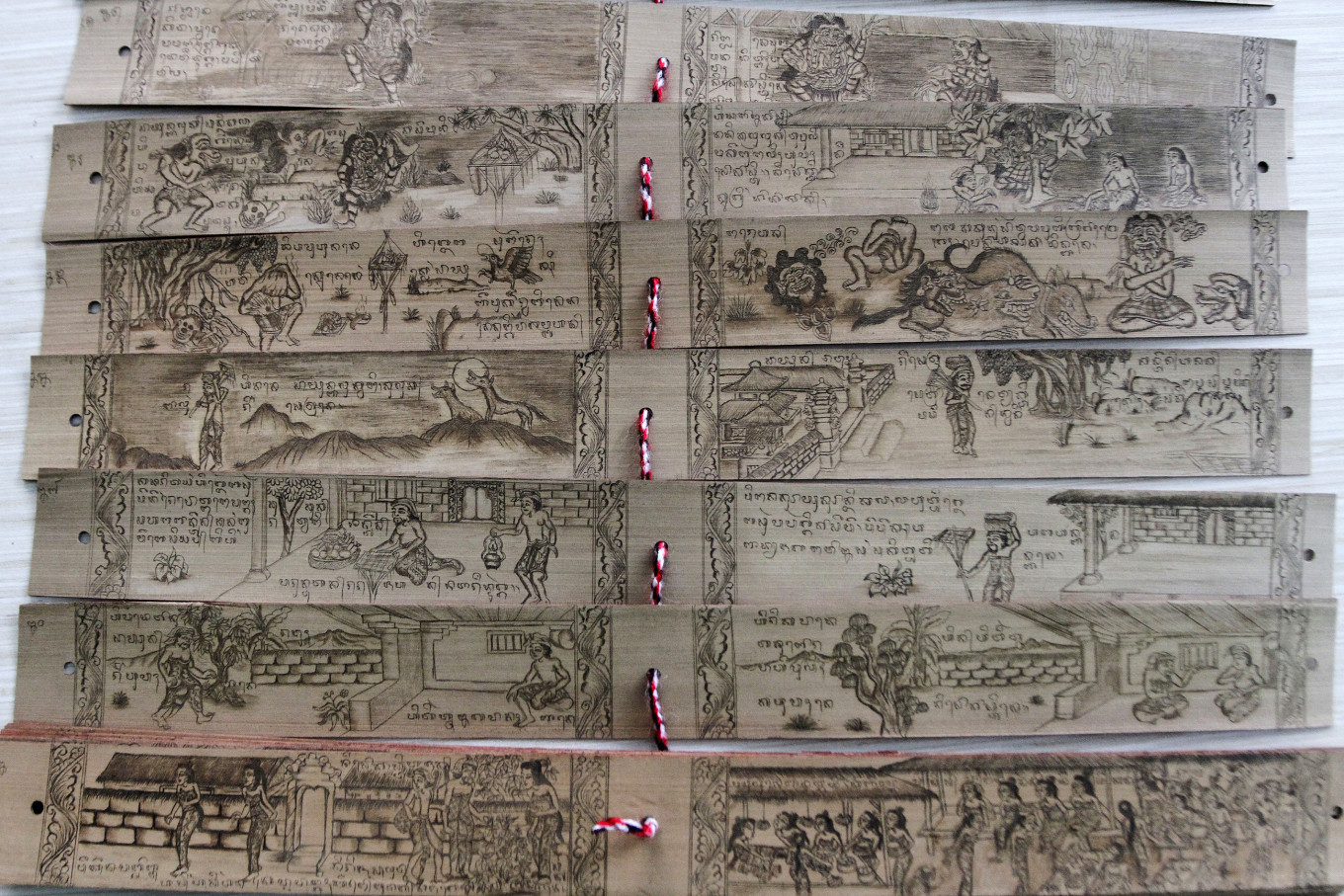
It is so unfortunate that the Latin script has supplanted the two main native scripts of Indonesia, Javanese and Balinese, because they are truly beautiful and adapted perfectly to writing on palm leaf manuscripts (curves curves curves). Printing on paper did them in; Javanese requires about twice as much space as Latin. Both scripts are descended from Kawi through Brahmi, like the scripts of the Philippines. The Javanese script was used to write Javanese as well as many of the other languages of Indonesia.
Balinese | (probably at least) 1500 CE | abugida | LtR | IN USE

I could not find a reliable date for the Balinese script; most scholars date its use from inscriptions made in 914, but those inscriptions are in Kawi, its immediate ancestor. Manuscripts in Balinese date to the 17th century, which seems too late, so I put it here with Javanese because they are clearly so closely related. I am afraid my little meager rendition of its alphabet does not do this incredible script justice - it is absolutely gorgeous, with enormous swoops and flourishes depending on word and sentence formation. Take a look at this palm leaf manuscript.
Gujarati | 1592 CE | abugida | LtR | IN USE

The Gujarati script was developed from Nagari in order to write the Gujarati language. The script is one of the official scripts of India and closely resembles Devanagari but without Devanagari's horizontal bar that (usually) connects its letters. I had to study the formation of the letters closely in order to determine which was which, because the stroke order affects the calligraphy. It's a beautiful script and reminds me of ribbons.
Lik Tai (Khamti) | ca. 1600 CE (or earlier?) | abugida | LtR | IN USE

The Khamti script is called Lik Tai by those who use it. It is a combination of Burmese plus some letter forms from Shan and Aitan. There are only 13,000 speakers of Khamti, so finding information about it was difficult. The Khamti people live in the borderlands of India, China, and Myanmar; the language is related to Tai.
Lepcha | ca. 1700 CE | abugida | LtR | IN USE

The Lepcha people adopted the Tibetan script to their own language's needs, resulting in the beautiful Lepcha script. Originally written vertically, it shifted to a left-to-right horizontal layout.
Rejang | ca. 1800 CE but probably much earlier | abugida | LtR | IN USE

The Rejang script is used by speakers of the languages of Sumatra. It descends from Kawi in the Brahmic family. Its first attestation is from 1800 but it is most likely much older than that, since scripts with similar appearances from the Kawi family date to 1300.
S'gaw Karen | 1830 CE | abugida | LtR | IN USE

The Karen script was developed fairly recently (1830) by Christian missionaries to Myanmar in order to translate the Bible into Karen. The missionaries used Mon-Burmese as a base. The language is not Tai, but Sino-Tibetan, making this script unusual for its language group. The Karen people have been at war with their government for decades; hence the script is most often taught in refugee camps.
1 Response
Leave a comment
Comments will be approved before showing up.
Ada Santiago
September 01, 2026
Wow, what an incredible deep dive into this fascinating topic! I loved reading through all these different scripts and noting similarities and differences (and yes, lamenting that the Latin alphabet has, unfortunately, taken over so much richness). What an act of passion this project must have been! Incredible. Thank you for sharing the behind-the-scenes with us and letting us nerd out with you for a bit.